
From ground preparation to the delivery of serviced platforms, Geotech Caraïbes masters the creation of every kind of level surface: industrial pads, parking areas, internal roadways, and storage yards. Operational rigor at the service of your projects in Saint-Martin and Sint Maarten.
A platform — whether an industrial yard, a parking area, a storage surface, or a site access road — is far more than simple ground leveling. It is a technical structure whose durability depends directly on the quality of its design, the preparation of the supporting soil, and the rigor of the compaction. In Saint-Martin, where soils vary widely and climatic stresses run high, that rigor is not optional: it is a necessity.
Geotech Caraïbes builds platforms for every type of project on the island, from temporary site access roads to large permanent industrial surfaces. Our command of earthworks, combined with our knowledge of Saint-Martin soils, allows us to offer technical solutions tailored to each context.
A platform is any horizontal or near-horizontal surface prepared to host activities or structures. Several types can be distinguished:
1. Geotechnical survey: before any earthworks, a precise reading of the supporting soil is essential. In Saint-Martin, the geological diversity — volcanic rock, clay soils, disturbed ground — calls for rigorous analysis to match the technical solution to the real characteristics of the terrain.
2. Topsoil stripping and preparation of the supporting soil: the topsoil layer, unsuitable as a foundation for structures, is stripped across the entire surface. The subgrade is then prepared and checked to reach the required mechanical characteristics.
3. Earthworks and grading to level: surplus cut material is hauled away, and low areas are filled with selected material. Grading to level is carried out precisely, with attention to the drainage slopes needed to run off stormwater.
4. Compaction in successive layers: the fill is placed in successive layers, each mechanically compacted. Compaction tests (Proctor, plate load) confirm that the required performance is met before the next layer is placed.
5. Capping layer and drainage: a capping layer of treated or untreated granular material ensures the bearing capacity of the platform and the runoff of rainwater. Its sizing accounts for the anticipated operational loads and the nature of the supporting soil.
6. Surface finish: depending on how the platform will be used — asphalt, concrete, compacted untreated aggregate, pavers — the finish is selected and installed to meet the functional and aesthetic requirements of the project.
7. Stormwater management: every platform must include a system for collecting and draining rainwater — gutters, drain inlets, ditches, connection to the stormwater (EP) network. In Saint-Martin's tropical setting, this point is critical to prevent flooding and erosion.
Soil bearing capacity: Saint-Martin shows wide variability in soil bearing capacity from one area to the next. The clay soils of low-lying areas have insufficient natural bearing capacity for industrial loads. Soil treatment (lime, cement) or the placement of a reinforced foundation layer may be required.
Drainage in a tropical setting: tropical rains generate large volumes of water over short periods. A poorly drained platform turns into a pond after every downpour and deteriorates quickly. Our platforms systematically incorporate drainage solutions suited to Saint-Martin's rainfall intensities.
Hurricane resistance: the structures and equipment placed on our platforms must withstand hurricane-force winds. This calls for suitable foundations and anchoring sized for extreme wind loads. The strength of the supporting platform is the first level of protection.
Machinery access: job sites in Saint-Martin are sometimes hard to reach — narrow roads, steep slopes, dense urban areas. Our diversified fleet (mini-excavators, compact machinery) lets us work in tight configurations without compromising the quality of execution.
Industrial zones and logistics depots: Sint Maarten is home to several industrial areas that require heavy-duty platforms. These surfaces, sized for truck and container loads, demand rigorous geotechnical design and high-quality compaction.
Hotels and resorts: hotel projects in Saint-Martin frequently include platforms for parking, terraces, service areas, and internal roadways. Our teams work in coordination with architects and landscapers to deliver work worthy of the island's high-end standards.
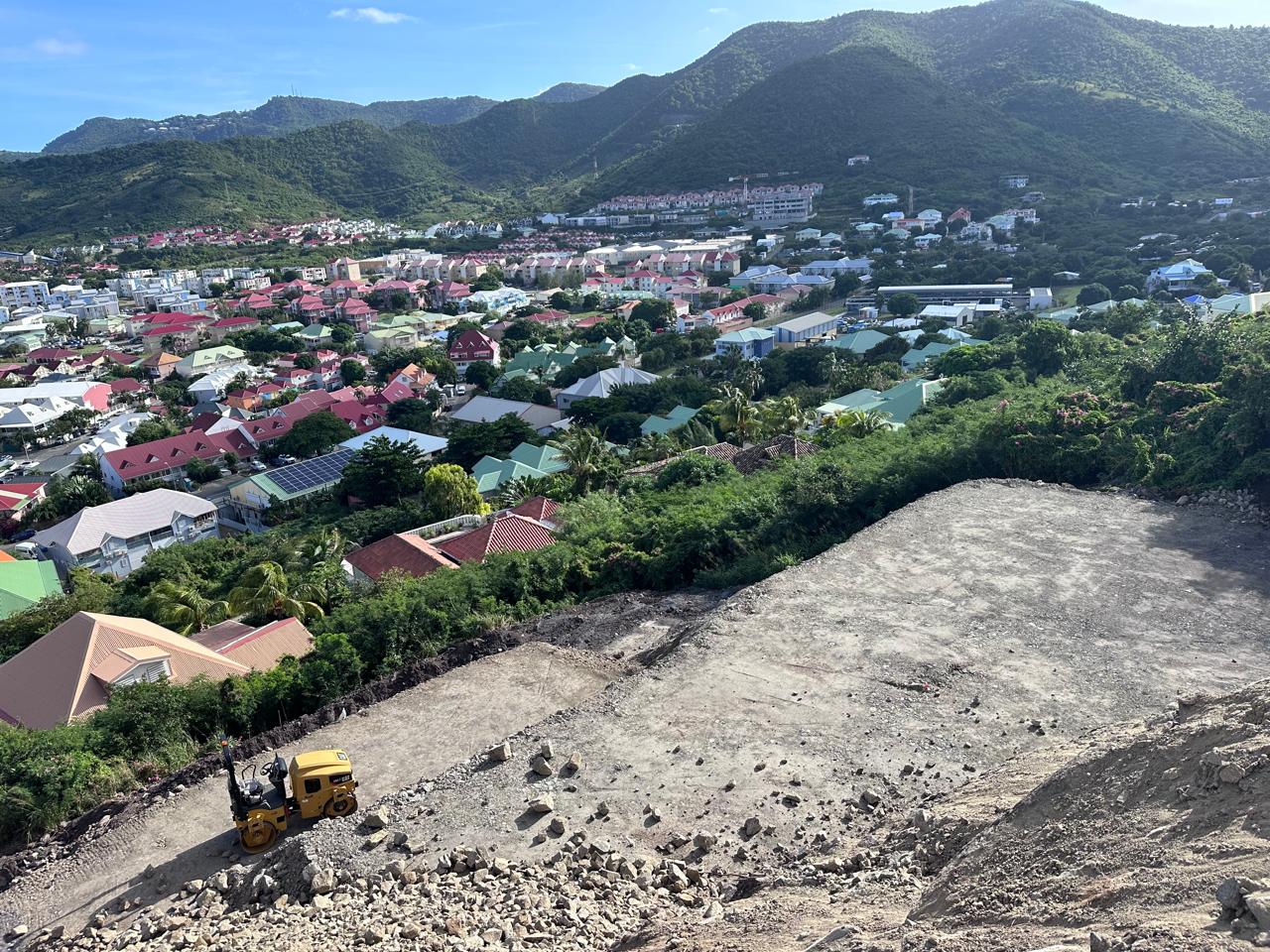
Residences and subdivisions: building platforms for villas on sloping ground is a frequent service in Saint-Martin. Leveling the terrain, building retaining walls, and laying out access roads form a technical package that Geotech Caraïbes handles end to end.
Construction sites: before major structural work begins, setting up a temporary construction platform is essential — access track, crane pad, storage areas. Geotech Caraïbes steps in ahead of the construction crews to prepare optimal working conditions.
Every platform project begins with a site analysis carried out by David Pivetta in person. This preliminary visit identifies the site's specific constraints, defines the most suitable technical solution, and produces a precise, transparent quote. Execution is then led by our teams with the same operational rigor we apply across all of our job sites.
Explore our expertise in dry and wet utility networks and in landscaping and outdoor works as well, to round out your platform project with quality site servicing and finishes.
The required bearing capacity depends on the anticipated operational loads. For traffic from 44-ton trucks, a minimum bearing capacity (EV2 modulus) of 50 MPa at subgrade level is generally required. For heavy forklifts or container storage, higher values may be demanded. Geotech Caraïbes performs in-situ control tests to guarantee the specified performance.
Draining a platform in a tropical setting relies on several complementary measures: adequate surface slopes (a minimum of 1 to 2%) for rapid runoff, perimeter gutters for collection, and connection to the stormwater (EP) network or to a retention basin. The sizing is calculated according to the peak flows of Saint-Martin's rainfall, factoring in hurricane intensities for permanent structures.
Yes, but it calls for special precautions. Expansive or compressible clay soils must be treated before the fill is placed: preliminary drainage, lime or cement treatment to improve the mechanical characteristics, or partial replacement with granular material. Geotech Caraïbes masters these soil-treatment techniques and adapts them to the real conditions of each job site.
Timelines vary with the surface area, the nature of the soil, and access constraints. A 500 m² platform on favorable ground can be built in 3 to 5 days. A large industrial platform of several thousand square meters takes several weeks of work. We draw up a detailed schedule during technical scoping, factoring in seasonal weather constraints.
The choice of finish depends on how the platform will be used. Hot-mix asphalt is the most common solution for roadways and parking areas — durable, easily repaired, and well suited to the loads. Concrete is preferred for areas of high static load. Compacted untreated aggregate is suitable for temporary or low-traffic platforms. Geotech Caraïbes advises you on the finish best suited to your project and budget.
Yes. Platforms built on sloping ground often require retaining walls to hold back the soil. Geotech Caraïbes builds these supplementary structures: reinforced concrete walls, gabion walls, and masonry or geosynthetic-protected embankments. These structures are sized to withstand earth pressures as well as the seismic and hurricane loads specific to Saint-Martin.
Entrust the building of your platform to Geotech Caraïbes — the local expert in earthworks and site utilities (VRD) in Saint-Martin. Free quote within 48 hours.