
Wastewater and stormwater pipework, potable water, electrical conduits, fiber optics, telecom — Geotech Caraïbes installs every buried utility network in Saint-Martin and Sint Maarten with the precision and rigor that underground infrastructure demands on an island territory.
Buried utility networks are the invisible infrastructure of every development project. Water, power, communications — without these underground networks, no building can function. In Saint-Martin and Sint Maarten, installing them calls for particular expertise: an island environment, constrained supply logistics, a dual regulatory context, and tropical climate conditions that test the durability of materials and structures.
Geotech Caraïbes masters the installation of all buried networks, whether wet or dry, from opening the trench to reinstating the surface finish. This end-to-end command guarantees friction-free interfaces between the different phases and technical consistency from start to finish.
Wastewater networks (EU): collecting domestic, commercial, and industrial wastewater is a major environmental concern in Saint-Martin. The sensitivity of the lagoon and coastal areas demands perfectly watertight networks, correctly graded and fitted with accessible control structures (inspection manholes) for maintenance. Geotech Caraïbes installs wastewater pipework in CR8 PVC and HDPE, from individual service connections to main collectors, including lift stations where the topography requires them.
Stormwater networks (EP): managing rainwater is an ongoing challenge in Saint-Martin. Tropical rainfall intensities — which can exceed 100 mm/h during intense storm events — require stormwater networks oversized relative to mainland-France standards. Geotech Caraïbes sizes and installs stormwater networks suited to the island's design flows: concrete or PVC pipework, drain inlets, manholes, grated channels, outfalls, and energy dissipators.
Potable water networks (AEP): the potable water supply is a precious resource in Saint-Martin, where fresh-water production depends largely on desalination and rainwater catchment. Our teams install potable water mains in HDPE or ductile iron, make connections to the public distribution networks, and fit metering and shut-off equipment. Pressure and disinfection tests are systematically carried out before commissioning.
Buried power: undergrounding electrical networks is a growing priority in Saint-Martin, both for aesthetic reasons (landscape, tourism) and for hurricane resistance. Overhead networks are especially vulnerable to extreme winds — Hurricane Irma brought that reality home brutally in 2017. Geotech Caraïbes installs TPC cable-protection conduits and concrete or HDPE pull chambers, in coordination with the network operators (EDF, local utilities).
Fiber optics and very-high-speed broadband: deploying fiber optics in Saint-Martin runs through underground civil-engineering works that Geotech Caraïbes masters completely: trenches, conduit installation, pull chambers, sealing, and roadway reinstatement. We work as a subcontractor for telecom operators or directly for private clients looking to connect their buildings to the high-speed network.
Telecommunications and special networks: beyond fiber, Saint-Martin has specific telecommunications networks tied to its island and tourism status (hotel networks, surveillance networks, alert systems). Geotech Caraïbes carries out the underground civil works (trenches, conduits, manholes) for these special networks.
Buried public lighting: installing the conduits and supply cables for public-lighting columns is part of our routine services, in coordination with the technical departments of the Collectivité de Saint-Martin and the Sint Maarten authorities.
When several networks (wastewater, stormwater, potable water, power, fiber) must be laid along the same route, a shared trench makes it possible to combine the works and reduce the impact on the roadway and neighboring residents. This approach, which Geotech Caraïbes masters completely, requires rigorous coordination among the operators of each network and compliance with the regulatory separation distances between the various pipes and conduits.
Marine corrosion: Saint-Martin's saline environment is especially aggressive toward buried materials. The choice of materials — HDPE, coated ductile iron, stainless steel — and of suitable cathodic protection is decisive for the durability of the networks. Geotech Caraïbes systematically selects materials suited to the island's corrosive context.
The water table: in certain low-lying areas of Saint-Martin, the water table is near the surface. Trench work in these conditions requires preliminary dewatering and special measures for laying the networks (joint watertightness, pipe ballasting to prevent flotation).
Existing networks: the density of existing networks beneath Saint-Martin's roadways can complicate new work. Geotech Caraïbes systematically files DT/DICT requests (Works Declaration / Declaration of Intent to Commence Works) before opening any trench and, where necessary, carries out manual trial pits to precisely locate neighboring networks.
Roadway reinstatement: any trench opened beneath a roadway must be closed to professional standards — backfilling in compacted layers, asphalt-treated base or lean concrete per the road authority's specifications, surface asphalt compliant with local technical requirements. Geotech Caraïbes performs these reinstatements in strict compliance with the requirements of the road authorities of Saint-Martin and Sint Maarten.
Installing buried networks is closely tied to earthworks and site utilities and roadworks (VRD). By entrusting all of this work to Geotech Caraïbes, you benefit from optimal coordination between phases — no conflicting interface between earthmovers and pipe layers, a unified schedule, and clear technical responsibility from the trench to the surface reinstatement.
It is this capacity for end-to-end intervention, combined with detailed knowledge of the Saint-Martin territory and constant operational rigor, that makes Geotech Caraïbes the reference partner for buried networks on the island.
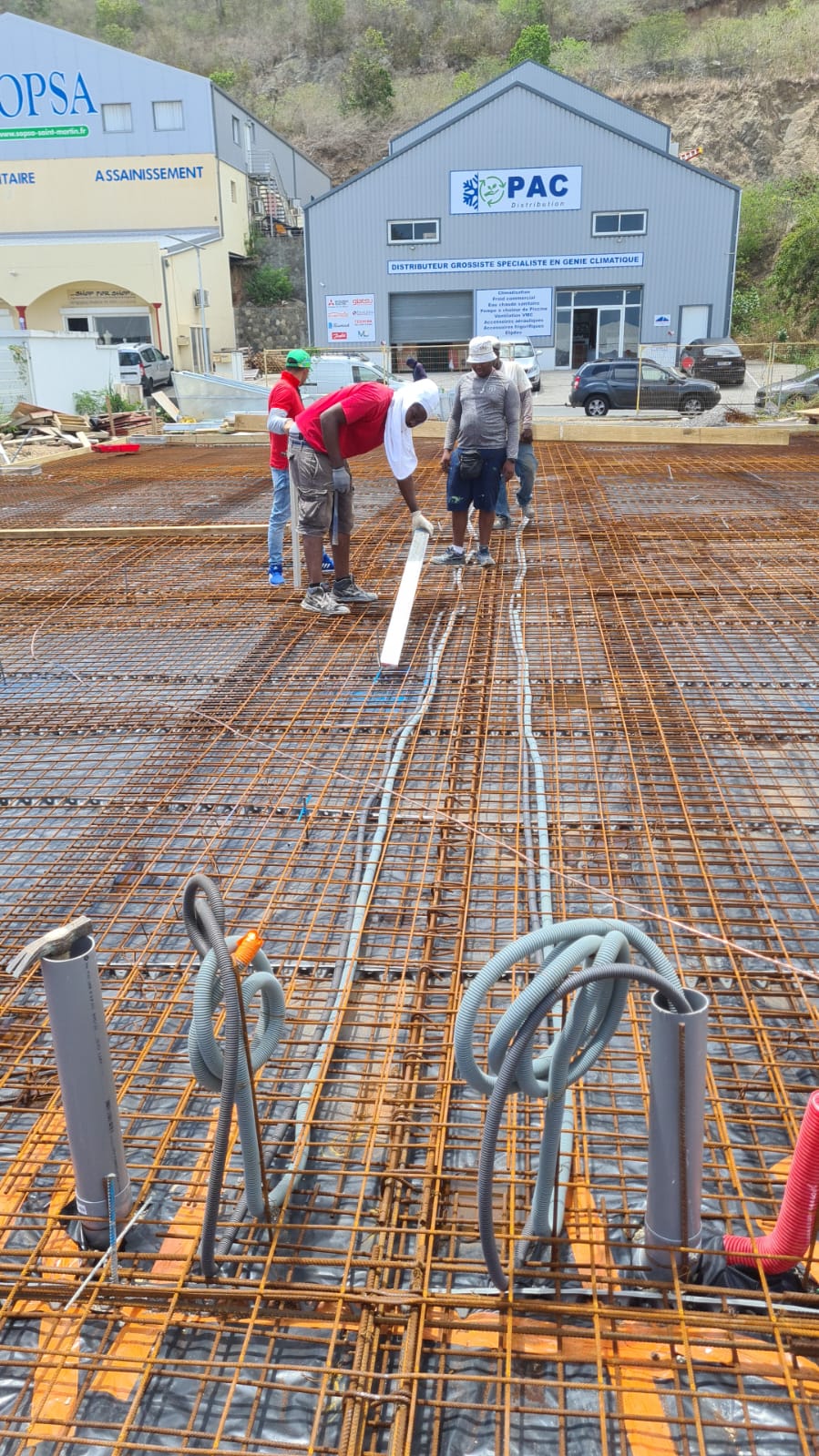
Minimum burial depths vary by network type and the specifications of local operators. As a guide: 0.80 m for wastewater and stormwater networks under green spaces, 1.00 m under roadway for gravity networks, 0.85 m for low-voltage electrical conduits, 0.60 m for telecom conduits. These depths may be increased in heavy-traffic areas or per the specific requirements of network operators in Saint-Martin and Sint Maarten.
Saint-Martin's saline, tropical environment calls for corrosion-resistant materials. We mainly use HDPE for pressure pipework and conduits, CR8 PVC for gravity networks, and coated ductile iron for large potable water mains. For metallic networks, cathodic protection can be installed. Concrete or sand bedding is systematically provided to protect the pipework during backfilling.
The DT (Works Project Declaration) and the DICT (Declaration of Intent to Commence Works) are mandatory procedures before any work near buried networks. They make it possible to identify the existing networks within the work area and to obtain the operators' plans. Geotech Caraïbes systematically completes these administrative steps before opening any trench, in compliance with the network damage-prevention regulations.
Geotech Caraïbes carries out the underground civil works (trenches, conduits, pull chambers) for electrical and fiber connections. The connection itself to the distribution networks (energizing, fiber connection) is performed by the competent network operators (electricity utility, telecom operator). We coordinate our work with these parties to ensure optimal continuity of service.
The duration depends on the length of the network, the pipe diameter, and soil conditions. For a 10-lot subdivision with 200 linear meters of wastewater network, expect 5 to 8 days of work, including the trenches, pipe laying, bedding, watertightness tests, and backfilling. Geotech Caraïbes draws up a precise schedule during technical scoping.
Yes, the shared trench is an economical, practical solution when several networks must be laid along the same route. It reduces roadway openings and the impact on neighboring residents. Strict separation rules between the different networks (minimum distances, warning mesh in different colors depending on the network type) must be observed. Geotech Caraïbes masters the coordination of shared trenches and organizes the installation in the required regulatory order.
Entrust the installation of your dry and wet networks to Geotech Caraïbes — the local expert in underground works in Saint-Martin. Free quote, rapid response.